
Key Takeaways: The biggest thesis problems we see aren’t about intelligence. They’re about structure, consistency, and last-mile checks. A small, focused review can prevent avoidable issues and give the fastest glow-up to any thesis, especially when paired with a final proofread with fresh eyes.
Table of Contents
Introduction
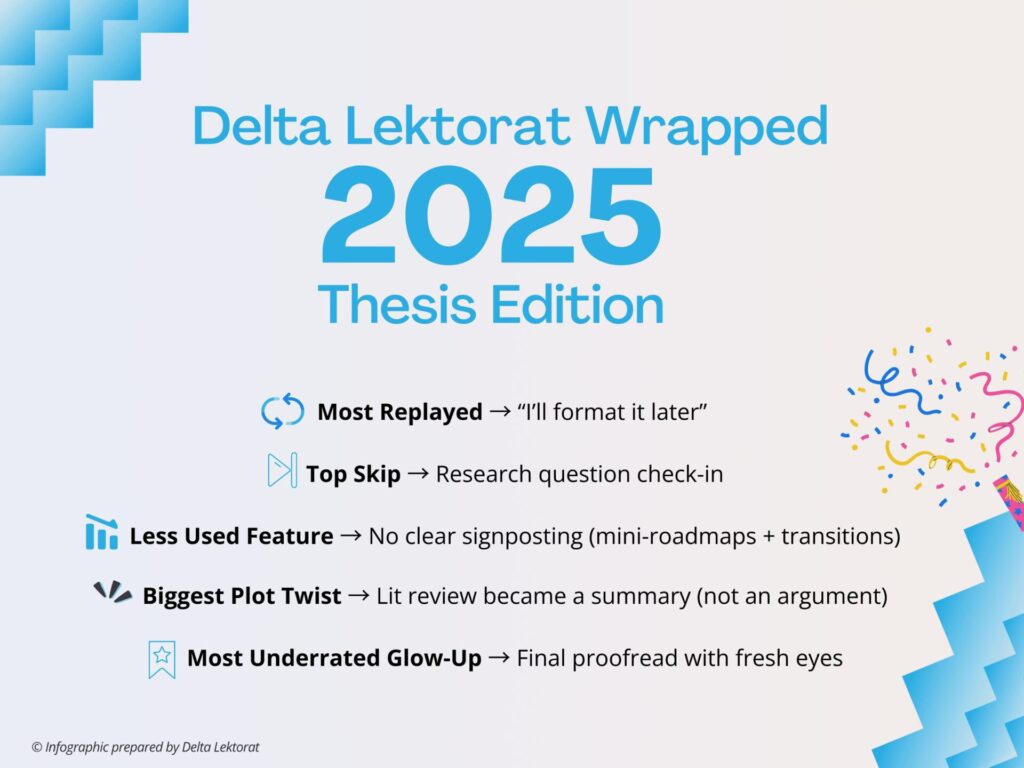
New year, new thesis energy! Welcome to Delta Lektorat Wrapped 2025 Thesis Edition: a look back at the patterns that appeared again and again in student drafts this year, and the upgrades worth carrying into 2026.
If you’re reading this with a half-finished chapter, 17 open tabs, and a document called final_final_v6, you’re in very good company. Grab a coffee and sit with us for a moment. This fun year-in-review takes a look at the most common trends and typical stumbling blocks surrounding theses. We highlight the most frequent mistakes, recurring patterns, and helpful lessons from 2025—so you can take them with you into the next year (or better yet: avoid them).
Lesson #1: Don’t Leave Formatting Until the End
We get it. Formatting feels like the boring part you’ll deal with once the whole writing is done. But in real life, leaving it until the end is how people lose hours to margin rules, heading chaos, broken tables, and a table of contents that refuses to behave. Don’t leave formatting until the very end – set up a clean structure from the start. That way, you’ll save yourself a lot of tedious reworking later, and your text will look professional and easy to read from the outset.
Pro tip: If allowed by the guidelines, choose the font Times New Roman.
Our studies show that theses written in Times New Roman are, on average, graded higher. Therefore, make sure to check whether your university guidelines permit this font. Use font size 12 and a line spacing of 1.5.
Task: Many universities provide their own thesis templates. Use them from the very beginning and follow the official guidelines.
Lesson #2: Keep Your Research Question on Track
Many theses don’t fail because of a weak topic, but because of a lack of internal coherence. The research question evolves during the writing process (which is completely normal), but the chapter structure often remains unchanged. The result is a literature review on topic A, a methods section for topic B, and a discussion that tries to hold everything together through sheer force of will.
Pro tip: Formulate an overarching research question and derive clearly defined sub-questions from it.
Each chapter should explicitly answer one of these sub-questions. This ensures that structure, content, and argumentation develop together—even if your focus shifts slightly during the course of your thesis.
To do: A 10-minute audit.
Lesson #3: Turn Your Literature Review into an Argument
This one is so common it’s basically a rite of passage. You read a lot, you take notes, you write… and suddenly your literature review is a neat list of who said what. Helpful, but not yet persuasive. What makes it feel academic isn’t the number of sources, it’s the synthesis: showing patterns, tensions, gaps, and how your study fits into the conversation.
Pro tip: Use our recommended AI tools strategically for your literature research and analysis process.
They help you find relevant studies more quickly, cluster them by topic, and identify recurring patterns of argumentation. This saves you time for what really matters: the critical interpretation and concise synthesis of the literature.
To do: Don’t just report the literature. Position your research inside it.
Lesson #4: Use Clear Transitions Throughout Your Thesis
The best theses are kind to the reader. They don’t make your supervisor or examiner work to understand your logic. They guide people through your thinking with small, simple cues: what you’re doing, why you’re doing it, and what comes next.
Pro tip: Write your structural sentences as if you were explaining them to someone outside your field.
If the beginning of a chapter or a transition is understandable to someone unfamiliar with your subject, it is usually also clear, precise, and easy to follow for examiners.
To do: Make your structure obvious.
Lesson #5: Schedule a Final Proofread with Fresh Eyes
By the time you’re “done,” you’re not actually seeing the text anymore, you’re seeing what you meant to say. That’s why tiny errors slip through, missing words, inconsistent terminology, awkward sentences, and references that almost match. A final proofread doesn’t change your ideas. It just makes them land cleanly.
Pro tip: Read your thesis at least once in a different format.
Printing it out, using a different layout, or reading it on a tablet instead of a laptop forces your brain to perceive the text differently—and makes surprisingly many errors visible.
To do: Proofreading is a milestone, not a bonus task.
Conclusion
If 2025 taught you anything, let it be this: your thesis doesn’t need more stress. It needs better defaults. Pick one lesson from this article and apply it this week, template your formatting, do the research-question audit, add signposting (transition text), or schedule your proofread. Small upgrades compound fast.
And if you want your own thesis “Wrapped” (with clear fixes, not vague feedback), you can explore Delta Lektorat’s proofreading and editing services here. If you want guidance and support while working through your thesis, our coaching service can help you stay on track and confident.
If you want to explore more insights and tips on thesis and academic writing, check out our blog here.
From our team to you: thank you for reading! Here’s to a successful writing season in 2026. We’ll see you next year with more blog posts and tips to support you on your academic writing journey.
Frequently Asked Questions (FAQs)
The biggest mistakes are not about intelligence, they’re usually about structure, consistency, and last-minute checks. Common issues include leaving formatting to the end, losing focus on the research question, turning the literature review into a summary instead of an argument, poor signposting, and skipping a final proofread.
Start with a structured template from day one, including heading styles, page numbers, captions, and citation rules. Writing directly inside this template saves hours of last-minute fixes and prevents table of contents chaos.
Treat your research question like a compass. Do a quick audit as you work on it: can you state it in one sentence? Does each chapter contribute to answering it? Trim or refocus chapters that drift.
A strong literature review synthesizes research by highlighting patterns, tensions, gaps, and how your own study fits in. Add a “So what?” sentence at the end of each theme to explain relevance and contribution.
Schedule it as a milestone, not a bonus. Ideally, take a break first, then review with fresh eyes, or ask a peer or professional editor. This catches small errors that can distract from your ideas.
Absolutely. Small, consistent upgrades, structured formatting, weekly research-question audits, clear signposting, and a final proofread compound quickly, making your thesis clearer and less chaotic.
Delta Lektorat offers proofreading, editing, and coaching services to help students align structure, strengthen arguments, and polish their thesis. Our goal is actionable feedback, so your work shines without extra stress.
Disclosure: This article was prepared by human contributors. Generative AI tools were used to support brainstorming, language refinement, and structural editing. All final decisions regarding content and recommendations reflect human judgment and expertise.
Note on references: This article is an editorial piece based on the practical experience of over 150 editors at Delta Lektorat who have reviewed real theses. As it is a practice-oriented guide rather than an academic paper based on prior research, no formal reference list is provided.

Dea Elmasllari, MSc.
Dea is a senior researcher passionate about helping students navigate the world of academia. She explores the intersection of Artificial Intelligence (AI) and scholarly work, offering insights on how technology can enhance writing, research, and learning. As the Head of Partnerships at Delta Lektorat, Dea leads collaborations with universities and student associations to promote excellence in academic writing and innovative approaches to thesis support. Her work focuses on bridging traditional academic rigour with emerging digital tools that empower students and scholars alike.
Share: