Writing the Theoretical Framework: A Step-by-Step Guide with Examples & AI Prompts
Writing the Theoretical Framework: A Step-by-Step Guide with Examples & AI Prompts
A well-founded chapter on the theoretical framework, also referred to by universities as the theory, literature background, or theoretical context, forms the scientific foundation of your thesis or dissertation. It connects insights from existing literature and secondary research into a clear conceptual framework. It defines key terms and central concepts, demonstrates their interrelationships, and explains which theories guide your research question(s), hypotheses, and the interpretation of your findings. This guide takes you through the essential elements, common pitfalls, and a practical step-by-step structure that you can adapt to qualitative, quantitative, or mixed-methods studies.
Dea Elmasllari, MSc.
31. July 2026
Key Takeaways: The theoretical framework ensures your thesis achieves intellectual coherence. It demonstrates which concepts you are applying, which theories you are drawing upon, and how your study builds on (or challenges) existing research. The fastest way to strengthen your framework is to select a small number of highly relevant theories, define your key concepts with precision, and lay out a clear logic: moving from theory to concepts, to expected relationships, and ultimately to your research question(s) and methodology.
Table of Contents
Introduction
A theoretical framework forms the academic foundation of your thesis or dissertation. It explains which theories and concepts are relevant to your research question and how they relate to one another. Crucially, it is not about listing as many sources or citations as possible. Instead, you define the core concepts of your study, contextualise the academic literature, and demonstrate which theoretical considerations guide your research.
In English-speaking academia, this type of chapter is frequently referred to as part of the Literature Review. However, a distinction must be made. This does not equate to a systematic literature review conducted as a standalone research method. Rather, it refers to a chapter that synthesises the theoretical context and current state of research. In German-speaking higher education, the theoretical framework and the literature review are either combined into a single chapter or addressed separately, depending on institutional guidelines. Furthermore, you are often expected to critically evaluate existing research within the literature review, highlighting current research gaps to justify the relevance of your own research question. A systematic literature review, by contrast, follows a strictly defined methodological approach, utilising predetermined databases, search strings, inclusion and exclusion criteria, and a transparent documentation of study selection.
Whether you are writing a Bachelor’s thesis, Master’s dissertation, PhD thesis, or an executive/postgraduate paper (such as a CAS, DAS, MAS, or MBA project): a compelling theoretical framework demonstrates that your study is built upon a sound scientific basis rather than personal assumptions.
At Delta Lektorat, we regularly observe promising research topics undermined by weak theory chapters. Frequently, topics are framed too broadly, resulting in extensive descriptions that lack a clear connection to the main research question. In other cases, the chapter remains overly superficial, relying on isolated definitions without properly contextualising or justifying them academically. Literature overviews also frequently summarise academic sources well, yet fail to develop a clear theoretical framework that justifies the research question and guides the entire study.
Unlike a general literature overview, which summarises and critically assesses the current state of research, a theoretical framework focuses specifically on the concepts and theories vital to your study. It illustrates how these elements interconnect and how they underpin your research question, hypotheses, and the interpretation of your results.
Drawing on our extensive experience in academic coaching and proofreading, this guide provides a step-by-step approach to help you build a clear, focused, and academically rigorous theoretical framework that meets the highest university standards.
Writing the Theoretical Framework: Key Components and Common Pitfalls
Before you start writing, ask yourself this central guiding question: Which theories and concepts are genuinely relevant to my research question?
A solid theoretical framework chapter typically includes the following core elements (the exact structure will depend on your field of study and your university’s specific guidelines):
Research Focus and Link to Research Question: Briefly explain the topic your study investigates and why the selected theories and concepts are relevant to it.
Key Terms and Definitions: Define the core terms of your thesis using academic literature, clearly specifying how they are understood within your study.
Relevant Theories and Models: Introduce the theories and models your work relies on, explaining their core principles in a clear, accessible way.
Interrelationships Between Concepts: Demonstrate how your core concepts connect and how together they build the theoretical framework for your study.
Contextualisation Within Existing Literature: Situate your thesis within the existing scholarly literature, showing which findings your study adopts, extends, or critically debates.
Hypotheses or Analytical Expectations (if applicable): Derive clear hypotheses or propositions directly from your theoretical framework, provided your research design calls for them.
Conceptual Model or Framework Diagram (optional): Visualise the most important concepts and their relationships using a clear, concise diagram if it aids reader comprehension.
Taken together, these elements highlight the importance of clarity, coherence, and theoretical focus.
Do’s:
Don’ts:
• Define key terms clearly and apply them consistently throughout your text.
• Explain theories in your own words and back them up with academic sources.
• Compare different scientific perspectives and justify your chosen approach.
• Focus on 1–3 core theories and analyze them in depth.
• Use a simple conceptual framework diagram to illustrate connections between concepts.
• List multiple definitions without choosing one for your own study.
• Rely on long direct quotes or textbook passages.
• Merely describe theories instead of critically contextualising them.
• Introduce too many theories without a clear focal point.
• Overload your diagram with too many elements or confusing arrows.
A compelling theoretical framework forms the thread of your thesis. It creates the scientific foundation for all subsequent chapters, ensuring a logical, coherent argument throughout.
Using Theory as an Interpretive Lens Throughout Your Thesis
Pro tip: Clearly introduce your core theory at the very start of your theory chapter and explain why it is suited to your research question. Later, revisit this theory in your Discussion chapter to contextualise and interpret your results against it.
Theory Chapter (Introductory sentence):"This study is grounded in [Theory/Model], which explains [core mechanism] and provides a framework for investigating [key constructs] in relation to [research question]."
Discussion Chapter (Revisiting theory): "In the context of [Theory/Model], these findings suggest that [brief interpretation], which aligns with / contradicts the proposed mechanism."
Use this checklist to ensure your theoretical framework is complete and academically sound:
Checklist for your Theoretical Framework
A Step-by-Step Guide with Example
A solid theoretical framework follows a clear, logical structure. The overview below demonstrates how to organize the core elements across three progressive steps.
Step
Content Elements
Purpose
Step 1: Contextualise Topic & Terms Guiding question: What is your study about?
Briefly introduce the research topic and situate the research question.
Define core key terms.
Establish the scope of your investigation.
Establish a shared foundation and clearly define the scope of the study.
Step 2: Explain Relevant Theories Guiding question: Which theory/theories explain your topic?
Select suitable theories and concepts, justifying your choices.
Explain central concepts and their interrelationships.
Compare different perspectives, where relevant to your study.
Ground your research on a scientifically sound theoretical foundation.
Step 3: Apply Theory to Your Study Guiding question: How is the theory applied in your study?
Derive hypotheses (quantitative), theory-guided assumptions (qualitative), or propositions (conceptual papers) from the theory (if applicable).
Demonstrate how the theory informs your methodology, analysis, and interpretation of findings.
Include a simple framework diagram if helpful.
Use theory to guide your methodology and frame the interpretation of your results.
Below is an abbreviated example illustrating the workflow. You can adapt it to your specific field of study.
Practical Example of a Theory Chapter
Step 1: Contextualise the Topic and Key Terms
• Briefly introduce the research topic and research question. • Define central key terms. • Establish the scope of your investigation.
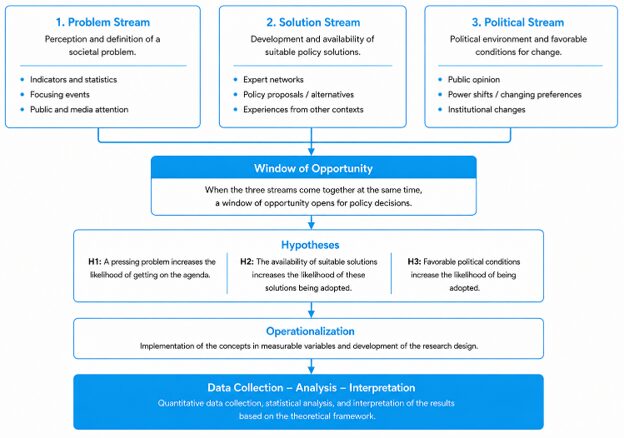
Example Text: This study investigates factors influencing the adoption of new national-level environmental policies. To address the research question, the Multiple Streams Framework (MSF) developed by Kingdon (2014) is applied. The model explains policy change as the result of three interacting streams: problem recognition, policy solutions, and political opportunities. The core concepts, problem stream, policy stream, and political stream, are defined below and form the foundation of this study's theoretical framework. The scope of investigation focuses specifically on factors that influence agenda-setting and the formal adoption of environmental policies.
Step 2: Explain Relevant Theories • Select suitable theory/theories and justify your choice. • Explain central concepts and their interrelationships. • Compare different approaches, where relevant to your study.
Example Text: The MSF has been widely applied to analyse agenda-setting processes and policy adoptions in environmental and public health domains (Brunner, 2008). According to Kingdon (2014), policy change is most likely to occur when the problem stream, policy stream, and political stream couple simultaneously, opening a "policy window". The problem stream captures how societal issues are perceived; the policy stream encompasses viable policy solutions; and the political stream reflects the broader political climate. The interplay among these three streams explains why certain policy initiatives are enacted while others fail. While alternative theoretical models offer complementary insights, they fall outside the primary focus of this study.
Step 3: Apply Theory to Your Own Study
• Derive hypotheses (quantitative), theory-guided assumptions (qualitative), or propositions (conceptual papers) from the theory (if applicable). • Demonstrate how the theory supports your methodology, analysis, and interpretation of results. • Include a simple framework diagram if helpful.
Option 1: Quantitative Study
Example Text: Based on the MSF, this study posits that environmental policies are more likely to be adopted when a pressing issue receives widespread attention within political discourse, viable policy solutions are available, and the political climate provides favourable conditions. From these theoretical premises, the following hypotheses are derived:
H1: A pressing problem in political discourse increases the probability that environmental policies will reach the political agenda. H2: The availability of suitable and feasible policy solutions increases the probability that environmental policies will be adopted. H3: Favourable political conditions increase the probability that environmental policies will be formally enacted.
To test these hypotheses, the theoretical concepts are operationalised into measurable variables within the research design. They serve as the foundation for data collection, quantitative analysis, and the interpretation of findings. Figure 1 summarises the theoretical framework and illustrates the relationships between the core concepts.
Figure 1 Theoretical Framework Diagram
Note. Author's own representation.
Option 2: Qualitative Study
Example Text: Based on the MSF, this study assumes that environmental policies are more likely to be adopted when a pressing issue receives widespread attention within political discourse, viable policy solutions are available, and the political climate provides favourable conditions. These theoretical premises yield theory-guided assumptions that form the analytical framework for the investigation. These concepts serve as the basis for developing the interview guide and establishing coding categories. Simultaneously, they provide the interpretive matrix for analysing the findings. Figure 1 summarises the theoretical framework and illustrates the interrelationships between the core concepts.
Additional Tips:
• Cite purposefully rather than excessively: A foundational theory and 2–3 empirical studies are usually sufficient to establish a well-grounded theoretical framework. • Establish a clear link to your research questions: The theoretical framework should logically explain why these specific questions are being investigated. • Demonstrate the connection to methodology: It should be evident how theoretical concepts are operationalised, applied, and analysed in your study.
After writing your theory chapter, ask yourself: Could an external reader easily understand which concepts are relevant to your study, why they matter, and how they guide your methodology, analysis, and interpretation of findings?
Using AI to Accelerate Your Theoretical Chapter
AI tools can assist you in structuring your theoretical framework. Among other benefits, they help organize relevant theories, present interrelationships clearly, and maintain consistent academic terminology. However, selecting the appropriate content and verifying all sources remains strictly your responsibility.
Below is a ready-to-use AI Mega-Prompt designed to help you construct your theoretical framework:
Mega-Prompt for a Clear Theoretical Framework
I am writing the theoretical framework chapter for my [Bachelor’s thesis / Master’s dissertation / PhD thesis] in [Subject Area]. Based on the information provided below, create a clearly structured and academically rigorous theoretical framework. Define the core concepts, explain the relevant theory/theories, and demonstrate logically how they relate to my research question and—if applicable—my hypotheses or theory-guided assumptions.
Structure the theoretical framework as follows:
Research Focus: Briefly contextualise the research question within the academic discipline and define the scope of the study in 2–3 sentences.
Key Terms and Concepts: Define the central terms and explain their significance to the study.
Core Theory/Theories: Explain the relevant theory/theories in an accessible yet academically sound manner. Add appropriate academic sources.
Theoretical Interrelationships: Explain the connections between core concepts and their underlying mechanisms.
Hypotheses, Assumptions, or Propositions (if applicable): Derive these logically from the theory.
My Study Details:
[Insert your research question(s), selected theory/theories, key terms and concepts, and any hypotheses/assumptions/propositions or expected relationships here.]
AI should be used as a supporting tool and must never replace your own critical thinking. Always verify all theoretical claims and references thoroughly. AI tools can generate inaccurate content or cite sources that are flawed, incomplete, or non-existent hallucinations.
Various AI platforms can assist you along the way. Claude, ChatGPT,Gemini, and Perplexity all handle this prompt effectively, each with different strengths. Keep in mind that while the prompt gives you a starting point and useful ideas to build upon, AI drafts are just drafts. Your role is to carefully flesh out and refine the content to ensure it authentically reflects your own academic argument.
In addition, always consult your university, department, or publisher guidelines regarding AI usage and disclosure, as these policies vary significantly. If declaration is required, state transparently which AI tool was used and for what purpose. Academic accountability rests entirely with you: all analyses, interpretations, and conclusions must be the product of your own critical judgement and should never be adopted blindly from AI-generated text.
Conclusion
The theoretical framework forms the academic foundation of your thesis or dissertation. By clearly defining central terms and concepts, selecting an appropriate theory, and presenting their interrelationships logically, you create a thread throughout your entire work. At the same time, you lay the groundwork for a robust methodology, a well-founded analysis of your findings, and a compelling discussion.
To ensure your thesis maintains academic consistency, every concept introduced must make a clear contribution to answering your research question. For further practical, step-by-step guidance, explore our detailed guides on writing the introduction, a methodology chapter, a results chapter, a discussion chapter, and conclusion of an academic paper.
If you would like to have your work professionally reviewed, Delta Lektorat supports you with expert academic proofreading and editing tailored to university standards. We ensure your thesis is linguistically precise, logically structured, and academically convincing.
Visit our blog to find additional guides, practical tips, and examples covering every aspect of academic writing.
The theoretical framework explains the theories and concepts relevant to your thesis, demonstrating how they guide your research question, methodology, and interpretation of results. A literature review critically evaluates existing scientific findings and studies. Depending on your university and subject area, the theoretical framework and literature review are presented either in a combined chapter or in separate chapters. A systematic literature review, by contrast, is a standalone research method in which scholarly literature is evaluated using a strictly defined, transparently documented procedure to answer a specific research question.
No, not necessarily. Whether your literature review and theoretical framework should be presented separately or together depends on your university's guidelines and academic field. At many German-speaking universities, both components are integrated into a single unified theory chapter (Theoretischer Hintergrund or Forschungsstand). In English-speaking universities (UK/US), the theoretical framework is typically integrated as a specific section within the broader Literature Review chapter, though doctoral theses or certain disciplines may require them to be written as two distinct chapters. Regardless of the layout, the core rule remains: the literature review critically evaluates prior research to identify gaps, while the theoretical framework defines the specific concepts and models guiding your study.
As a rule of thumb, 1 to 3 core theories are sufficient. You should only include additional theories if they add clear value to answering your research question and can be seamlessly integrated into your overall framework.
Not always. Hypotheses are standard in quantitative studies. In qualitative research, you can use theory-guided assumptions or guiding concepts instead.
Yes, provided it clarifies your underlying logic. Keep it simple and ensure that every element shown in the diagram is also fully explained in your text.
Lecturers and examiners look above all for a clear focus, a logical structure, and an academically sound argument. Key concepts must be explicitly defined, theories precisely explained, and their relevance to your research question and methodology clearly justified. Delta Lektorat supports you by refining the language and structure of your theoretical framework, ensuring conceptual coherence across chapters, and establishing a logical thread. This ensures your theoretical framework serves as a robust scientific foundation for your entire thesis, rather than just a summary of existing literature.
Disclosure: This article was prepared by human contributors. Generative AI tools were used to support brainstorming, language refinement, and structural editing. All final decisions regarding content, recommendations, and academic insights reflect human judgment and expertise.
References
Brunner, S. (2008). Understanding policy change: Multiple streams and emissions trading in Germany. Global Environmental Change, 18(3), 501–507. https://doi.org/10.1016/j.gloenvcha.2008.05.003https://doi.org/10.1016/j.gloenvcha.2008.05.003
Swales, J. M., & Feak, C. B. (2012). Academic writing for graduate students: Essential tasks and skills (3rd ed.). University of Michigan Press.
Dea Elmasllari, MSc.
Dea is a senior researcher passionate about helping students navigate the world of academia. She explores the intersection of AI and scholarly work, offering insights on how technology can enhance writing, research, and learning. As the Head of Partnerships at Delta Lektorat, Dea leads collaborations with universities and student associations to promote excellence in academic writing and innovative approaches to thesis support. Her work focuses on bridging traditional academic rigour with emerging digital tools that empower students and scholars alike.
Dr. Meriton Ceka
Meriton is a scholarly author, lecturer, and researcher with many years of experience supporting academic writing. He assists students and researchers in producing structured, clear, and persuasive work. As the founder of Delta Lektorat, he collaborates closely with universities to promote academic excellence through professional feedback and methodological clarity.